There has not been a single dull moment during the 2025-26 Sixers season. What else would anybody have expected?
One of the best parts of covering this team is engaging with passionate fans. And, every week, readers have answered calls for questions for Sixers mailbags. While this will be the final mailing of this regular season, they will persist – not just for however long the Sixers keep their postseason alive, but every single week.
This week, a Paul George question will kick us off before going answering a larger batch of questions than usual in quick succession. Thank you to anyone who has submitted questions at any point over the last several months.
Let's dive into the final Sixers mailbag of the 2025-26 regular season:
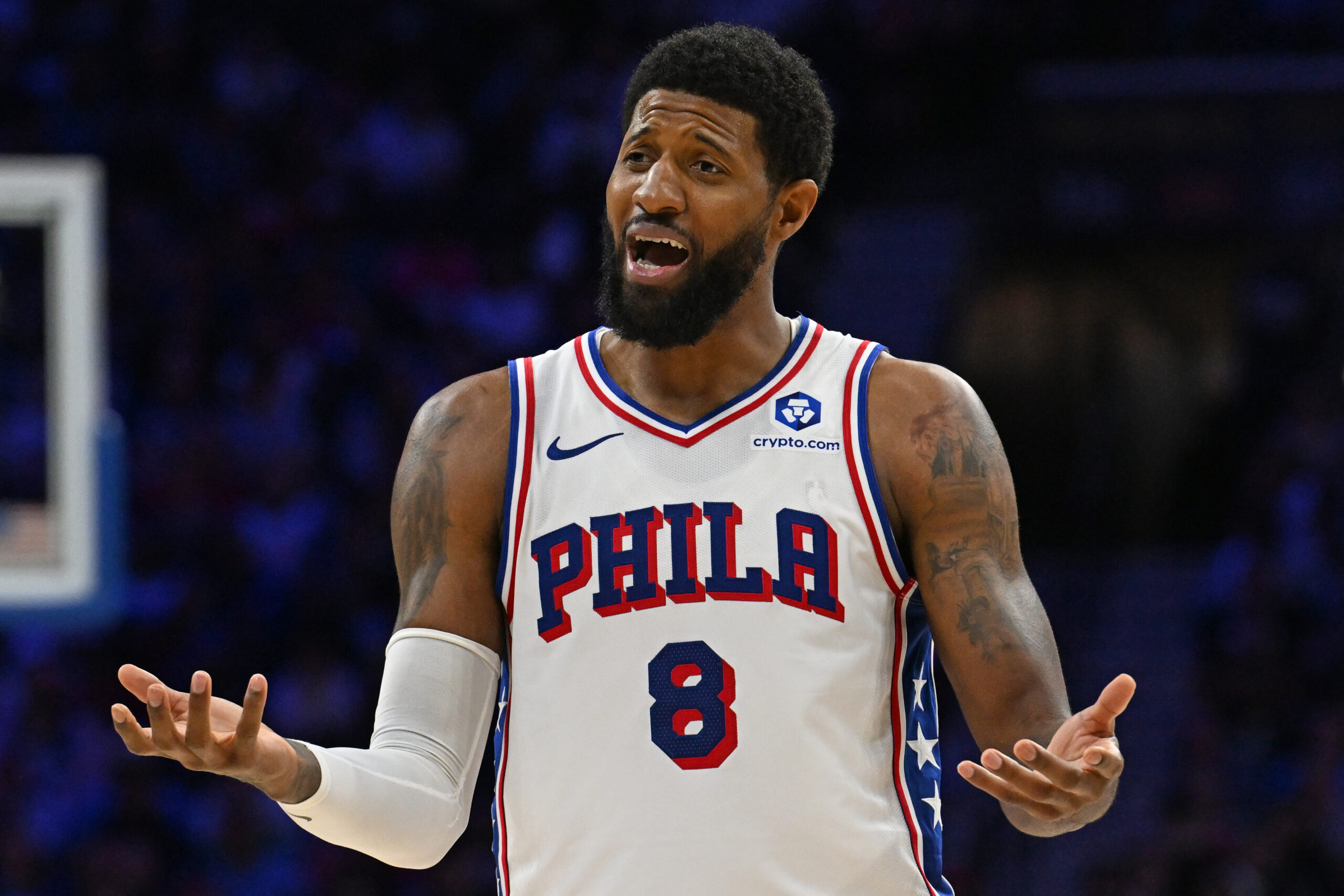
From @rjankowich.bsky.social: Is there any chance that Paul George's resurgence would make him tradable this offseason?
There are two ways to define "tradable" in the NBA. One definition: is the player now a positive-value asset which a team would give something of meaning up for? The other: is it conceivable that the player could be dumped and made another team's problem if its current organization wants to move on?
Even as George shines in the aftermath of his 25-game suspension – looking far more spry and healthy than he has in nearly two full seasons with the Sixers – it remains just difficult to imagine him having trade value. George will turn 36 years old in three weeks and change. He will make over $54.1 million in 2026-27 before encountering a player option worth more than $56.5 million for the following season. If George follows through on his goal to play all 10 games left on the Sixers' slate upon returning, he will have played in 78 out of a possible 164 regular-season games since arriving in Philadelphia.
It is not just that a team could not sell itself and its fans on George's production matching his salary. That is a difficult case to make in isolation, to be clear, as George will likely slot in as the 11th-highest-paid player in the entire NBA next season. Even for an incredibly impactful and scalable player, as George has been over the last two weeks, meeting that sort of price point is quite an ask.
The bigger issue teams will have: selling themselves on George being available enough to pay off his contract. Many teams will be skeptical that George would be worth his price tag if he played 70 games in a season. And his recent history of unavailability – he missed time with a long list of injuries before missing more than a quarter of this season due to his suspension – does not exactly inspire confidence that the total package will be worth in excess off $110 million over the next two seasons.
But could this run make it easier for the Sixers to reroute George – potentially in exchange for other unwanted salary – if they deemed that to be the best path forward? It certainly will not hurt. The phrase "sell high" is not well-liked around these parts anymore, so we will not go there. But it only takes one team, as the saying goes. This might sound wildly simple, but it would be a lot easier for the Sixers to trade George this summer than it would have been last summer because of the sheer fact that it is now a two-year deal.
Do not look now, but George's contract is about 14 months away from being one of the largest expiring contracts in NBA history. George could be the ultimate salary filler piece once next season is over with; whichever team has him next offseason could have a chance to use his deal to land a new star – or even use it to find multiple high-level contributors on expiring deals considered to be more impactful in the aggregate than George would be on his own.
The expectation should continue to be that George will be with the Sixers next year. But your thought is an interesting one. And perhaps George's recent surge combined with the length of his commitment decreasing makes him a viable option for someone. After all… it only takes one team.
MORE: What is different about post-suspension Paul George?
From @kwhelan11: Is next year the year we should expect going into the luxury tax?
There is no practical benefit to ducking the luxury tax threshold from a team-building perspective, but when teams do it, the most reasonable rationale they can provide beyond simply deciding to save money: getting under the tax line now makes it easier to go over it later. There are penalties for repeat offenders; teams that go over the tax line routinely end up spending hundreds of millions of dollars in tax payments. Of course, the Sixers have avoided assuming tax bills repeatedly in recent years, and nobody is going to believe that they will pay one until it actually happens. But the norm has become the Sixers entering the season over the tax line, but not by so much that they cannot get under it with a trade or two. Perhaps if their season goes exceptionally well in the opening months, ownership will approve more spending than it has at past deadlines.
From @hallublin.com: How bad is our cap space this offseason? Will we finally be forced to choose one or the other of Quentin Grimes and Kelly Oubre Jr. or is there a feasible path to bring both back?
The Sixers are going to be over the salary cap when the offseason starts. That is okay; the NBA has a soft cap which teams are allowed to surpass. Do not expect them to be bidding on the highest-end free agents, though. Their means to upgrade the roster in any meaningful capacity will be limited, but Grimes and Oubre are the swing pieces of the summer. Both players will be unrestricted free agents, and both will be Full-Bird free agents, meaning the Sixers can give them any amount of money as long as they are not hard-capped at either apron. Here is a mailbag from last month, which dives into the specific figures involved in the Sixers' offseason with a specific focus on the duo of Grimes and Oubre.
From @top5andamnot5: Do you think Tyrese Maxey is able to sustain 40-minute average through the playoffs?
Maxey has largely sustained that workload for the marathon that is a regular season, and perhaps his three weeks on the sidelines due to his right finger injury represented the best possible outcome for his legs. If there is anyone willing to test the limits of how much Maxey can play, it is Sixers head coach Nick Nurse. Maxey, who battled an illness for part of that six-game series against the Knicks, still averaged a whopping 44.5 minutes per game. Even before Nurse arrived, the Sixers rode Maxey as much as they could; he logged 39.4 minutes per game in his final two playoff runs under Doc Rivers.
Whether it is sustainable or not, the Sixers are going to have to push Maxey. Their roster has not proven to be good enough to beat elite teams without players like Maxey and Joel Embiid playing as much as they possibly can.
MORE: Can major changes can be made this offseason?
From @Maz4lini: Rank the Pistons/Celtics/Cavs/Knicks from the best matchup to worst matchup for Philly assuming full health for everyone
Even after what happened on Saturday night, if Cade Cunningham is unavailable for any part of a series, the Detroit Pistons represent the least of four evils here. The Sixers will be clear underdogs in any first-round series they are a part of, and rightfully so, but if they faced the Cunningham-less Pistons, there is at least a somewhat viable vision for the Sixers catching a team at the right time.
If Detroit is fully healthy, they are the second-toughest matchup possible, only behind the Boston Celtics, not only the best team in the conference according to many indicators – with Jayson Tatum now back and looking far better than anyone expected – but also a uniquely challenging matchup for the Sixers. They have two brilliant wing scorers that coexist beautifully, plus several outstanding role players. They have more high-caliber options to defend Tyrese Maxey than any other team in the Eastern Conference, plus bigs with size and three-point shooting ability. They have, in the eyes of many, the best head coach in the NBA in Joe Mazzulla.
Cleveland has two tremendous ball-handling guards and a pair of formidable two-way bigs, and the Sixers will have trouble matching up with James Harden and Donovan Mitchell while also battling with Evan Mobley and Jarrett Allen. Cleveland's trade deadline has been a success; they are a far deeper team now. Max Strus is back, which is a big deal for them. He joins a group of viable role players including Dean Wade, Dennis Schröder and Keon Ellis.
Then there are the New York Knicks, the current No. 3 seed and the Sixers' most likely opponent in a world in which they avoid the Play-In Tournament. Everyone remembers the six intense games between the Sixers and Knicks in the first round two years ago. More specifically, they remember the Knicks bullying the Sixers on the offensive glass, and the Sixers' inability to end defensive possessions costing them their season. Fast forward to 2026, and the Sixers still have very few answers for players like Mitchell Robinson and Josh Hart.
But those around the Knicks this season would attest to this: for much of the season, they have not seemed nearly as good as they look on paper. They remain reliant on a five-man lineup which, in a sample of nearly two full seasons, has just not been all that good. They are very beatable. The question is: can the Sixers be the ones to beat them?
MORE: Embiid calls out Daryl Morey, derailing the mood after Sixers' statement win
Follow Adam on Twitter: @SixersAdam
Follow PhillyVoice on Twitter: @thephillyvoice
Have any thoughts?
Share your reaction or leave a quick response — we’d love to hear what you think!
-
 0
0
-
 0
0
-
 0
0
-
 0
0
-
 0
0
-
 0
0