
The Pennsylvania Supreme Court has ruled that mandatory life sentences for second-degree murder are unconstitutional, delivering a decision long sought by criminal justice advocates.
Pennsylvania and Louisiana had been the only two states with laws requiring mandatory life sentences without parole for second-degree murder. The Supreme Court's ruling found the requirement "inconsistent with the protections bestowed upon our citizens" that prevent "cruel punishments," Chief Justice Debra Todd wrote in the court's 72-page opinion.
MORE: City Council to go 'back to the drawing board' on amending resign-to-run law
Second-degree murder applies to cases in which a life is taken during an attempt to commit another felony such as robbery, rape, burglary, arson or kidnapping. Those directly responsible for the death and any other accomplices involved in the felony that led to it can be charged. The action that causes the death does not require malice, and defendants can be convicted even if the death was accidental.
"Life without parole imposes the harshest imprisonment sanction permitted under the law ─ imprisonment until death without the opportunity for consideration of release ─ regardless of culpability," Todd wrote. "Due to this scheme’s mandatory nature and its unique severity, it poses a great risk of disproportionate punishment."
Thursday's ruling will have a stay of 120 days to allow the state legislature to determine necessary changes to sentencing laws.
Pennsylvania Gov. Josh Shapiro, who was the former state attorney general, praised the decision.
"I have long believed this law is unjust and wrong," Shapiro (D) wrote in a post on X. " … Common sense and true justice dictate that we need different penalties for different conduct. For example, the getaway driver shouldn’t get the same sentence as the person who pulls the trigger."
'Justice should be individual'
More than 1,100 people convicted of second-degree murder are now serving mandatory life sentences in Pennsylvania. The Supreme Court's ruling now raises questions about whether and how those inmates could seek pathways to resentencing pending changes to the state's criminal statute.
The Supreme Court's review stemmed from an appeal made by attorneys for Derek Lee, a 37-year-old man who was involved in a robbery that took place in Pittsburgh in October 2014. Lee was one of two intruders who broke into the home of Leonard Butler and his girlfriend to demand money from the couple.
Lee was upstairs when his co-defendant, Paul Durham, fatally shot Butler, who had lunged at him in the basement, investigators said. Lee was convicted of second-degree murder and sentenced to life in prison without the possibility of parole. He was found not guilty of first-degree murder.
Bret Grote, legal director of the Abolitionist Law Center, which represented Lee, said the Supreme Court's ruling will have "profound ramifications" for incarcerated people and their families in Pennsylvania. Other prominent criminal justice organizations also hailed the court's decision.
“We are overjoyed for the hundreds of people in Pennsylvania who will be reunited with their loved ones as a result of this decision,” said Nikki Grant, co-executive director of Amistad Law Project, a public interest law center based in West Philly. “Like countless other people incarcerated in Pennsylvania, Derek Lee has worked to make amends for the harm he’s caused in spite of the inhumane conditions of prison, not because of it. We applaud the PA Supreme Court for acknowledging long prison sentences are counterproductive to public safety."
Philadelphia District Attorney Larry Krasner said there are more than 500 Philadelphians serving mandatory life sentences for second-degree murder. Thursday's ruling "throws into question" those inmates' futures, Krasner said, and raises other concerns for the families of homicide victims going back decades.
"The prospect of facing over 500 potential resentencings — I mean, it's very doable," Krasner said. "But it does require the dedication of a lot of time and a lot of resources to make sure that we do justice in these cases, and that we do individual justice, which is a fundamental point of this opinion by the Pennsylvania Supreme Court. The fundamental point is that justice should be individual — not mechanical, not robotic."
Lawmakers propose solutions
The Supreme Court's ruling puts pressure on lawmakers in Harrisburg to address uncertainties in the new legal landscape, including whether the decision applies retroactively to inmates already serving life sentences.
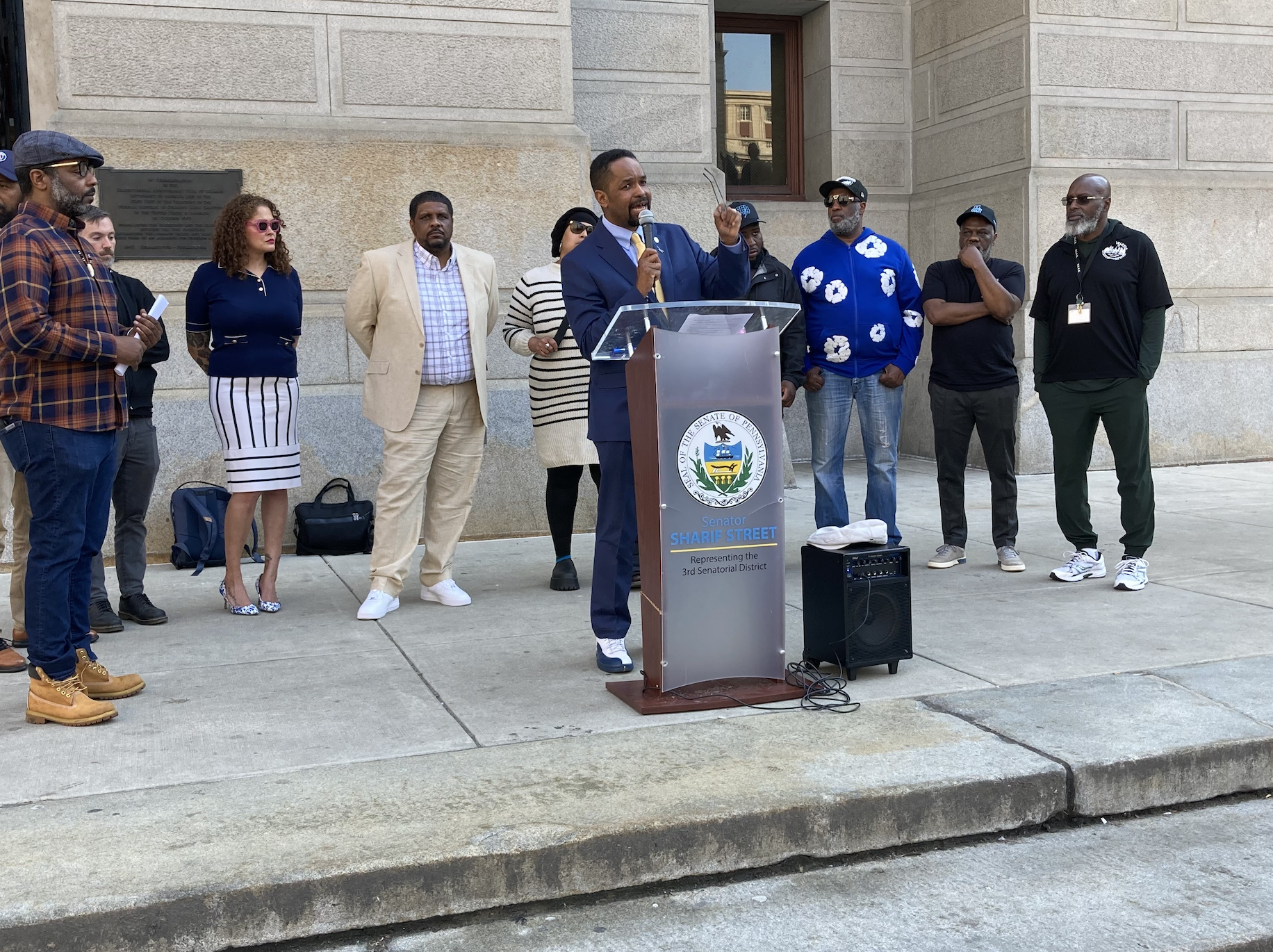
At a news conference outside City Hall on Thursday afternoon, state Sen. Sharif Street (D) called the Supreme Court's decision long overdue and said the existing law has been "a total miscarriage of justice" that guarantees "death by incarceration."
In some cases, Street said the law has given defendants directly responsible for homicides more leniency than their co-defendants charged with second-degree murder.
If the victim in a fatal shooting garnishes a weapon, for example, the shooter can argue there was provocation that led them to act in self-defense. The shooter might have a first-degree murder charge reduced to third-degree murder, making them eligible for parole after 25 years, but a co-defendant who was at the scene would still face life in prison for second-degree murder.
"We've talked to individuals who were serving 40 years for being an accomplice to a crime where the person who pulled the trigger had been home for 15 years already," said Street, who was joined Thursday by other lawmakers and criminal justice advocates.
Street and Sen. Camera Bartolotta (R) are co-sponsors of a bill that would end mandatory life sentences without parole for second-degree murder. Their bill would maintain life sentences but allow for parole eligibility case-by-case, including reviews for those already serving sentences.
Under the proposed bill, adults convicted of second-degree murder would need to serve 25 years before becoming eligible for parole. Juveniles between 15 and 17 would need to serve 20 years before parole eligibility. Inmates under 15 would need to serve 15 years before becoming eligible.
"This bill does not guarantee release. It guarantees review," Street said.
In the House of Representatives, another bill sponsored by Rep. Tim Briggs (D) proposes similar solutions. The proposals will need to be reconciled in both chambers over the next 120 days.
Briggs said more than 700 inmates sentenced for second-degree murder in Pennsylvania have already served more than 20 years in prison. More than 300 of them are over 60 years old.
"Not only are they serving unconstitutional sentences, but they are also the most expensive inmates in our system," Briggs said in a statement. “Justice demands we act to right the wrongs of our past."
Street urged lawmakers to move swiftly in Harrisburg.
"We've delayed the justice for these individuals long enough," Street said.
Have any thoughts?
Share your reaction or leave a quick response — we’d love to hear what you think!
-
 0
0
-
 0
0
-
 0
0
-
 0
0
-
 0
0
-
 0
0