Many Irish bars are named after the person who opened it, or maybe someone they knew. That's certainly the case for McGillin's Olde Ale House, Con Murphy's, Fergie's Pub and countless other spots in Philadelphia. But a few of the places pouring Guinness and plating shepherd's pie require a bit of a history lesson.
Ever wondered how that bar on Arch Street got its unusual constellation of accents and vowels? Or whether there was a real Finn McCool? Here's the Celtic mythology, Gaelic phrasing and Irish history behind six pubs in the city. Brush up before the St. Patrick's Day celebrations begin this weekend:
MORE: St. Patrick’s Day Parade: Road closures, parking restrictions, SEPTA detours and how to watch
Finn McCool's
118 S. 12th St.
In Celtic mythology, Fionn mac Cumhaill was the leader of an elite band of warriors known as the Fianna. He was no ordinary man, but a hero with magical powers — and, in some tellings, a giant. Among his exploits? Eating the so-called Salmon of Knowledge, from which he gained all-encompassing wisdom. Using a magical spear to defeat a fire-breathing creature that terrorized the royal court every Samhain festival. Legend has it, he even created the Giant's Causeway in Northern Ireland while battling his Scottish rival.
How does all this lead back to the Center City bar Finn McCool's? Fionn mac Cumhaill's name is sometimes anglicized to Finn MacCool or Finn McCool.
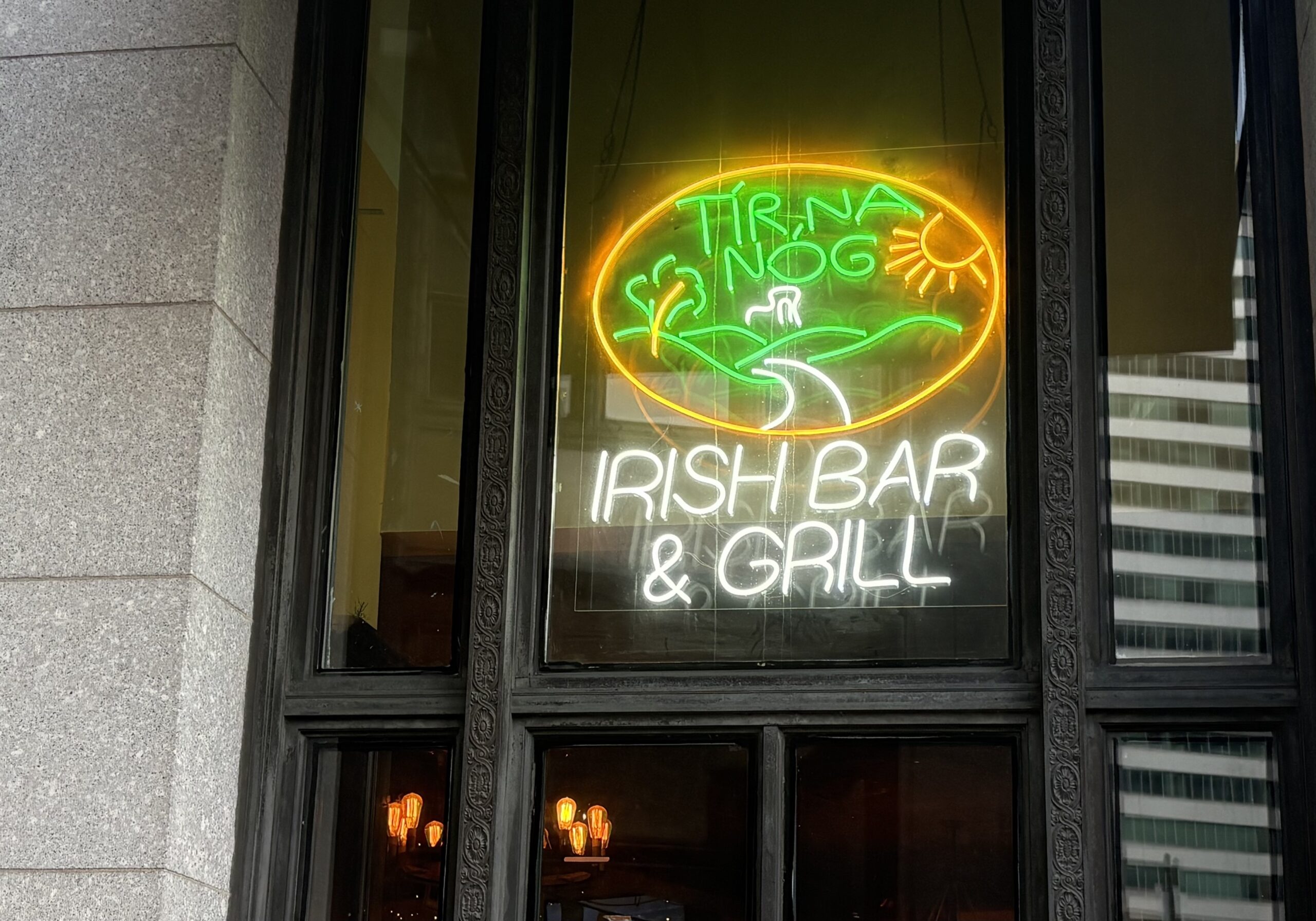
Tir Na Nog
1600 Arch St.
Fionn's family continued to figure prominently in ancient lore. His poet son Oisín stars in a well-known story about the Celtic "otherworld" where gods roamed. It was called Tír na nÓg, the land of eternal youth.
Though Oisín begins his life in the mortal world, he settles in Tír na nÓg after falling in love with one of its inhabitants: Niamh, daughter of the sea god Manannán mac Lir. Even as he starts a family of his own, Oisín misses his parents and yearns to return to Ireland. Niamh tells him he may visit on one condition: He cannot step foot off her white horse. When he arrives, he finds that hundreds of years have passed and his loved ones are long dead. Then, as he leans over to help a group of old men move a boulder, he slips off the horse. Hitting the ground, he instantly reverses the powers of Tír na nÓg. Now an extremely old man, Oisín dies.
The Plough & the Stars
123 Chestnut St.
The Plough & the Stars isn't just the name of the longtime Irish bar in Old City. It's also a flag the Irish Citizen Army flew during the Easter Rising, the 1916 insurrection against British rule that helped pave the way for the Irish War of Independence. The green and yellow banner depicts a plough and sword dotted with stars. It's in the shape of the Big Dipper, which the Brits and Irish call the Plough.
Irish writer Seán O'Casey also named his play about the Easter Rising "The Plough and the Stars." When it premiered in Dublin in 1926, it incited riots. Several audience members objected to the depiction of the insurrection, barely a decade old at that point, but others felt O'Casey was too kind to the sex worker character who appears in Act II.
Black Taxi
745-747 N. 25th St.
Black taxis have been popular across the U.K. for decades. They became the default cab option after 1945, according to the London Museum, because black models like the Austin FX4 were the cheapest. But the cars have an added meaning in Northern Ireland, where "black taxi tours" are offered. Tourists who sign up learn the history of Belfast — with a special emphasis on the complicated and violent period known as the Troubles — from cabbies who lived through it.
Fado
1500 Locust St.
The national chain of Irish bars, which came to Philadelphia in 2001, draws its name from the Gaelic word for "long ago." It's meant to indicate the start of a great story, the kind that founder and former Dublin accountant Kieran McGill heard in pubs growing up.
The Monto
226 Market St.
It's not open yet, but bar owners Fergus Carey and Jim McNamara will soon turn the former Mac's Tavern space in Old City into another Irish pub. (They also own Fergie's Pub, the Jim and the Goat Rittenhouse.) This one will be called the Monto, after the folk song "Monto (Take Her Up to Monto)" popularized by the Dubliners in 1966. It's about a former red light district in northeast Dublin supposedly patronized by King Edward VII and James Joyce.
"It's a great song, and I've been singing it for over 40 years," said Carey, who grew up in Dublin. "It's close to my heart."
Follow Kristin & PhillyVoice on Twitter: @kristin_hunt
| @thePhillyVoice
Like us on Facebook: PhillyVoice
Have a news tip? Let us know.
Have any thoughts?
Share your reaction or leave a quick response — we’d love to hear what you think!
-
 0
0
-
 0
0
-
 0
0
-
 0
0
-
 0
0
-
 0
0