
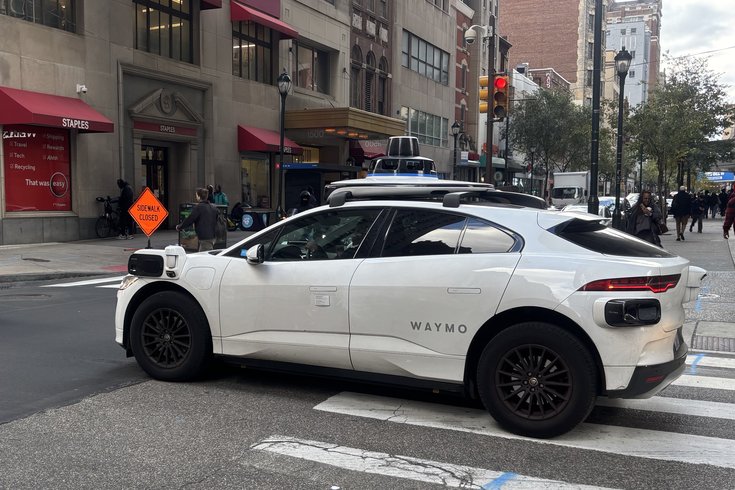
Waymo is moving forward with plans to roll out service in Philadelphia after road-testing its robotaxis in the city over the summer.
Philly is one of 20 new cities — including Pittsburgh, Baltimore and Washington — where Waymo plans to expand in the coming years. The company did not provide a timeline for its autonomous vehicles to debut in Philly. When they first become available, they will have drivers behind the wheel.
MORE: New cruise ship terminal to open beside Philly airport next spring
"In each city that we operate in we have a period during which we drive autonomously with specialists behind the wheel," Waymo spokesperson Ethan Teicher said. "We use that period to validate our performance while we scale up our operations."
Waymo has received PennDOT's permission to begin operating autonomously with drivers in their cars, Teicher said. The company's next step will be to get regulatory approval for fully autonomous driving.
PennDOT and the city did not immediately respond to requests for comment on Waymo's announcement.
In July, Waymo started testing its cars on Philly's streets and highways with drivers behind the wheel to sync its mapping technology with the urban streetscape. The company's fleet includes Jaguar I-PACE SUVs and Chrysler Pacifica hybrid minivans. The cars were spotted around town over the summer, but they were not available for rides.
Waymo initially will serve Philly's "downtown core" before operations are expended, including rides to and from the suburbs, Teicher said. The company will follow a similar phased approach in Pittsburgh, initially rolling out Waymo cars with manual drivers before transitioning to autonomous driving.
Waymo's first fully driverless robotaxis became available for rides in Phoenix five years ago, and the company since has rolled out service in Los Angeles, San Francisco, Atlanta and Austin. It is introducing fully autonomous cars in Miami on Wednesday and will make them available in Dallas, San Antonio, Houston and Orlando in the coming weeks.
Public perception of the safety of autonomous vehicles remains split. In February, a AAA survey found that 61% of Americans are afraid to ride in self-driving cars. More than half of those surveyed said they would not use self-driving services like Waymo and Cruise, the GM-owned venture that shut down its commercial robotaxi business two years ago amid scrutiny over a high-profile crash with a pedestrian in San Francisco.
Waymo has continued to pop up in news reports highlighting safety concerns. A self-driving Waymo taxi hit a dog in San Francisco on Sunday and another driverless vehicle drove within feet of a police stop in Los Angeles later that night.
"Safety is our highest priority at Waymo, both for people who choose to ride with us and with whom we share the streets," a Waymo spokesperson said after the incident in Los Angeles. "When we encounter unusual events like this one, we learn from them as we continue improving road safety and operating in dynamic cities.”
Waymo claims its safety data shows greater reliability than manually operated cars despite news coverage of isolated incidents.
In a May study published in the journal Traffic Safety Prevention, Waymo's own analysis of its fleets in Austin, Los Angeles, Phoenix and San Francisco found there were 85% fewer crashes with serious injuries and 92% fewer crashes involving injuries to pedestrians when its cars were compared with human drivers. The study was peer-reviewed by outside traffic safety experts. The company also debuted a data dashboard last year offering transparency into the company's safety profile.
The list of places Waymo is expanding includes London and Tokyo — the company's first international ventures — in addition to U.S. cities like Tampa, St. Louis, Minneapolis, Detroit, Nashville and Seattle.
Have any thoughts?
Share your reaction or leave a quick response — we’d love to hear what you think!
-
 0
0
-
 0
0
-
 0
0
-
 0
0
-
 0
0
-
 0
0